

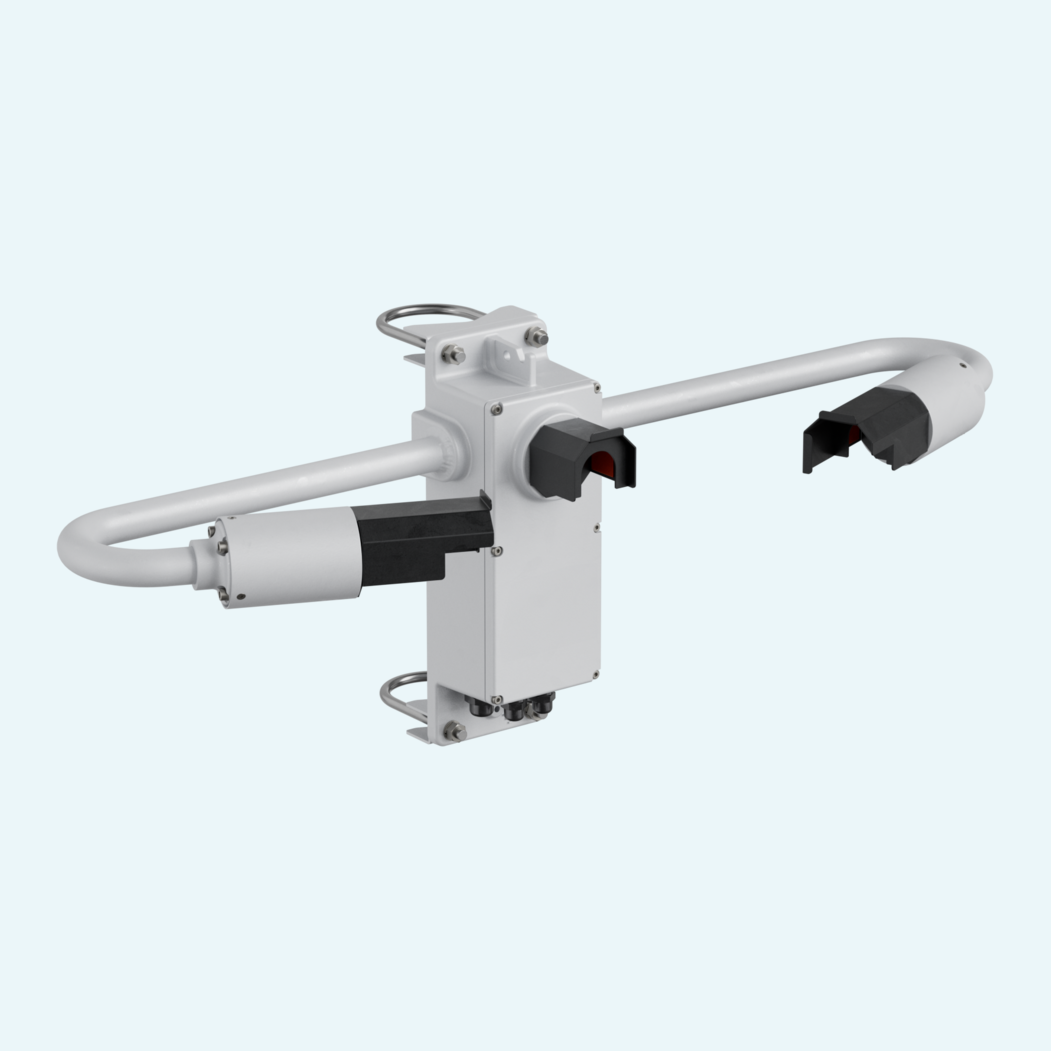
Critical weather decisions need more than a visibility value. For aviation, national observation networks, and demanding weather monitoring sites, this compact sensor combines long-range visibility measurement with advanced present and past weather reporting in one outdoor-ready instrument.
A forward-scatter optical geometry measures Meteorological Optical Range (MOR) and atmospheric extinction coefficient (EXCO) across a default 10 m to 75 km range, with the maximum selectable up to approximately 99,99 km. The dedicated backscatter receiver strengthens precipitation classification, helping separate liquid and frozen precipitation and identify a wider range of weather types.
Daily operation is kept practical in all-weather sites. Window heaters, heated hoods, and automatic contamination monitoring are fitted as standard, while continuous self-test and two-stage cleaning warnings support planned maintenance. RS-232, RS-422, and RS-485 outputs simplify system integration, and the optional ALS-2 interface appends ambient light data for METAR and RVR applications.


Reports Meteorological Optical Range and atmospheric extinction coefficient over a configurable visibility range.
Provides WMO Table 4680 and METAR present and past weather reporting, with optional country-specific definitions.
Uses 39° to 51° forward scatter geometry, centred at 45°, to measure particles in the sample volume.
Adds a dedicated backscatter channel for precipitation type determination using intensity, transit time and signal ratio.
Provides standard RS-232, RS-422 and RS-485 serial outputs for integration into monitoring systems.
Supports an optional ALS-2 Ambient Light Sensor interface that appends ambient light data to the SWS-250 message.
Monitors key functions continuously and can simulate visibility, present weather, contamination and fault conditions.
Includes fitted hood heaters, window heaters and contamination monitoring across all sensor head windows.
Code: 25. [1] [2] [3] [4] [5] [6] [7]
Example: 25.A.HV.J.A.NA.UK.RC
[1] Housing
Blank = Powder coated aluminium (standard)
A. = Hard coat anodized, powder coated
[2] With heating
HV. = With heating
[3] Standard outputs (RS-232 / RS-422 / RS-485)
J. = Standard outputs (RS-232 / RS-422 / RS-485)
[4] Advanced self-test and monitoring
A. = Advanced self-test and monitoring
[5] Option board
NA. = Without ALS-2 Interface
WA. = With ALS-2 Interface
[6] Precipitation Definitions
xx. = Country code
The list of Country Codes is available on the website and must be included in the order code. For further information, please contact your sales representative.
[7] Configuration
RC = Regular configuration
SC = Special configuration