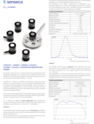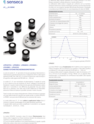
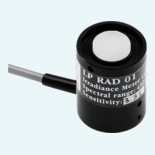
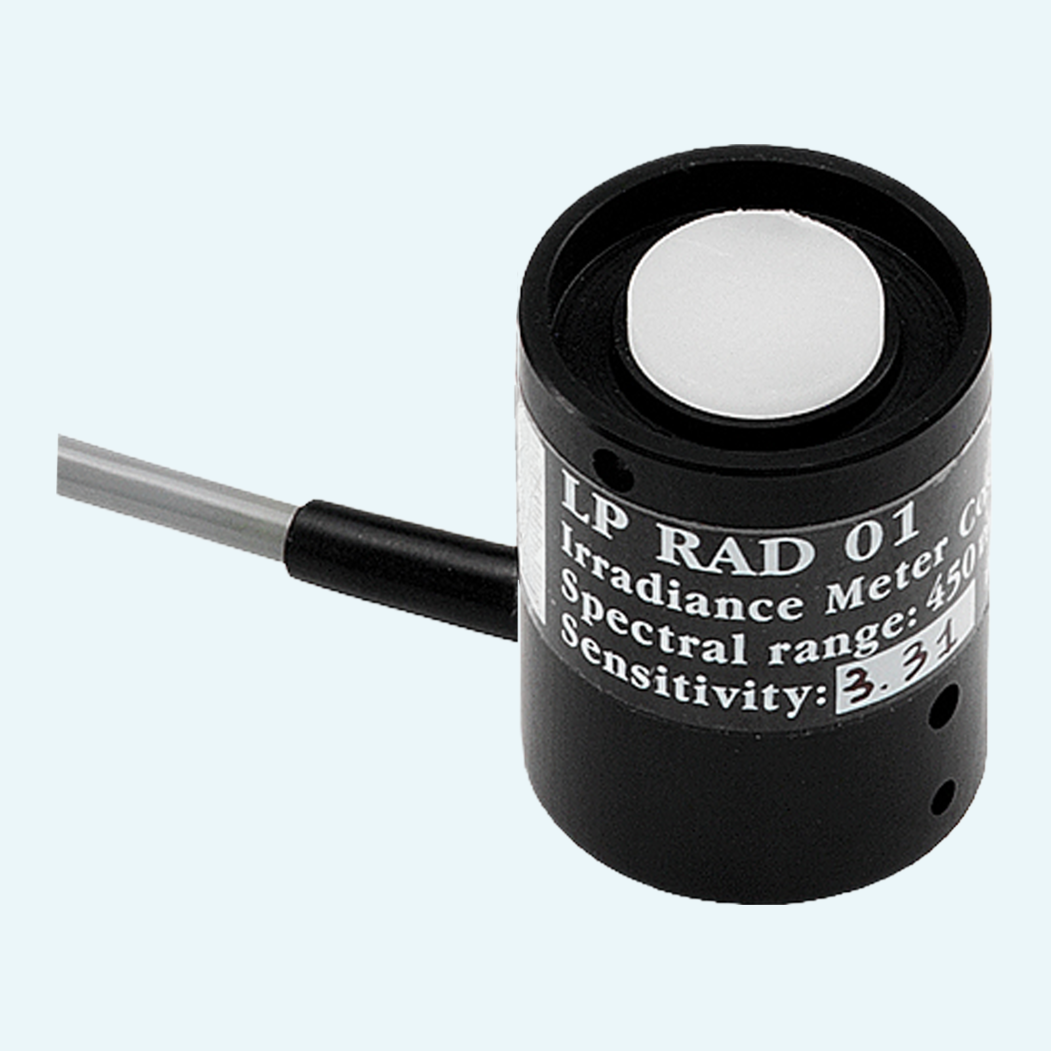
Reliable irradiance monitoring starts with a probe that keeps the measurement chain simple. LPRAD01 measures VIS-NIR irradiance in the ≈400 nm…≈1050 nm spectral region and provides a direct voltage output, without the need for an external power supply.
For indoor applications that require constant radiometric monitoring, the probe converts photodiode current into a potential difference that can be read with a suitable voltmeter. The measured value is calculated using the calibration factor marked on the probe housing, giving each sensor its own traceable reference point.
The compact Ø 30 mm x 38 mm housing and 5 m cable make LPRAD01 easy to integrate into measurement setups. With a measuring range of 0…200 mW/cm2, typical sensitivity of 2.6 μV/μW/cm-2 and calibration accuracy below 6%, it gives technical users a practical, low-complexity way to monitor irradiance in the VIS-NIR range.


The photodiode generates current when struck by light, and the internal resistor converts it into a potential difference for reading with a voltmeter.
The probe measures irradiance as energy flow per surface area in the spectral region from ≈400 nm to ≈1050 nm.
The output signal is read in mV and used with the probe-specific calibration factor to calculate the measured irradiance value.
Calibration is carried out using 577/579 nm lines of a Xe-Hg lamp filtered through a special interferential filter.
For 1% reading precision of the potential difference, the probe must be connected to a digital multimeter with input resistance >100 kΩ.
The output signal can be converted to 4…20 mA or 0…10 Vdc using compatible HD978TR series converters.