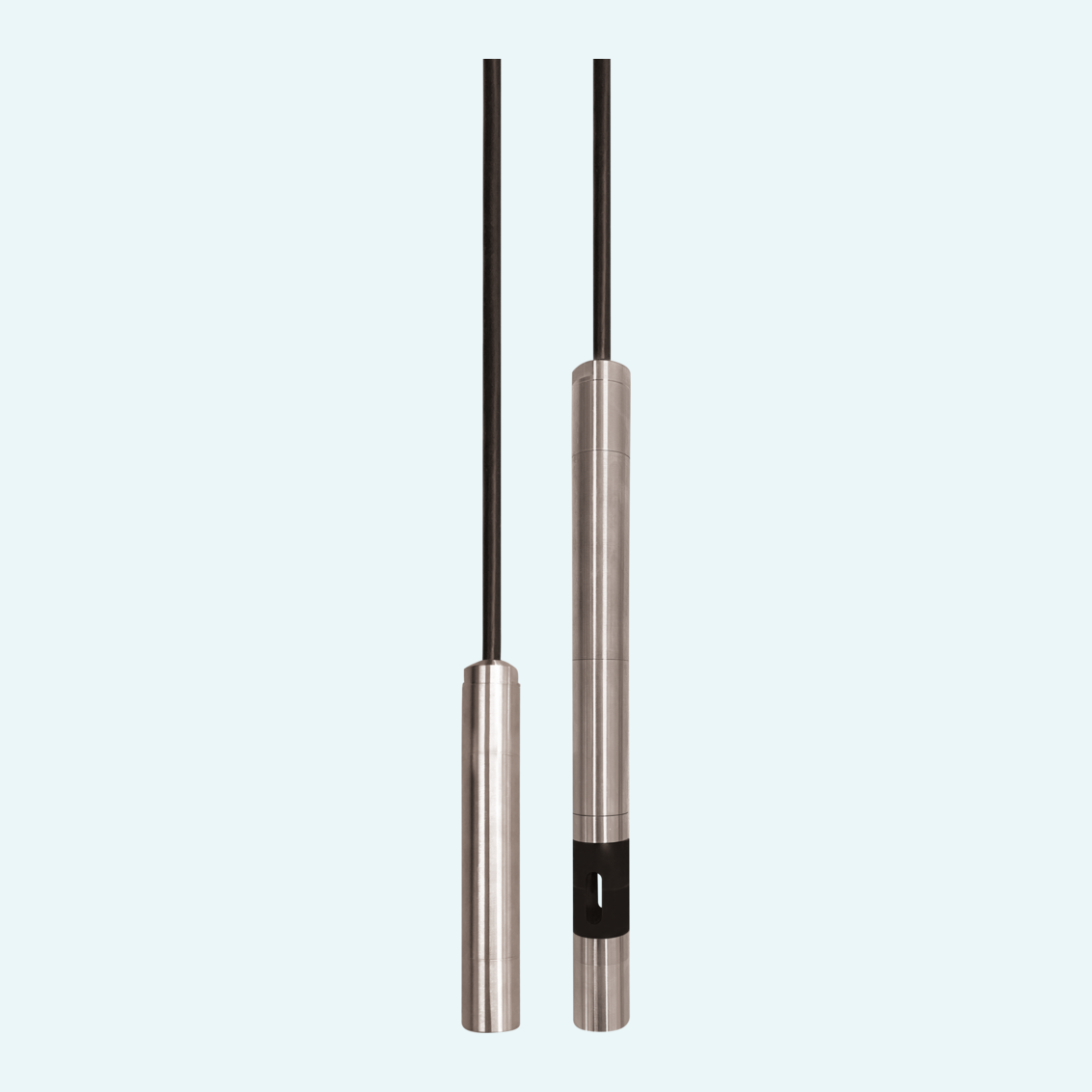
Reliable level measurement starts with a sensor that can stay stable in real process conditions. Designed for continuous monitoring and control of liquid levels and temperatures, this hydrostatic transmitter is well suited for fresh water, wastewater and saltwater applications, including confined spaces such as small-diameter sounding tubes.
A capacitive 99.9% Al2O3 ceramic sensing cell measures hydrostatic fluid pressure directly via the process diaphragm. The slim Ø22 mm stainless steel design, ingress protection (IP68) up to 100 m/20 bar and support cable with steel core help maintain dependable operation under low temperatures, shock and vibration loads.
For integration into plant systems, the family offers 4…20 mA with FSK communication or RS485 Modbus-RTU. Optional Pt100/Pt1000 temperature measurement and a 4-electrode conductivity cell up to 0…50 mS/cm extend the device beyond level monitoring when additional water-related parameters are needed.

The device measures liquid level via hydrostatic pressure acting directly on a capacitive ceramic pressure cell with a process diaphragm.
The family covers relative pressure ranges from 0…100 mbar to 0…20 bar and level ranges from 0…1 mH2O to 0…100 mH2O, depending on the selected variant.
Optional Pt100 3-wire or Pt1000 temperature inputs are available. In RS485 Modbus-RTU versions, the measured temperature value can be read via the digital interface.
The optional conductive 4-electrode cell measures conductivity from 0…50 mS/cm with temperature compensation and a reference temperature of +25 °C.
Available electronics include 4…20 mA with FSK communication and RS485 Modbus-RTU. The RS485 version supports 9600 baud as standard, with 4800…38400 baud configurable.
Process-contacting materials include 99.9% Al2O3 ceramic, stainless steel 1.4404/316L, 1.4571/316Ti or 1.4462/318LN duplex, plus FKM/FPM, EPDM, PE, PUR and epoxy.
The device is specified for -20…+70 °C process and ambient temperature, 50 g impact resistance and 20 g vibration resistance.
Standard, ATEX/IECEx Category 1 and ATEX/IECEx Category 2 approval variants are listed in the product code, depending on the selected configuration.