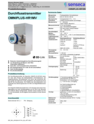
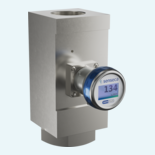
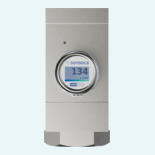

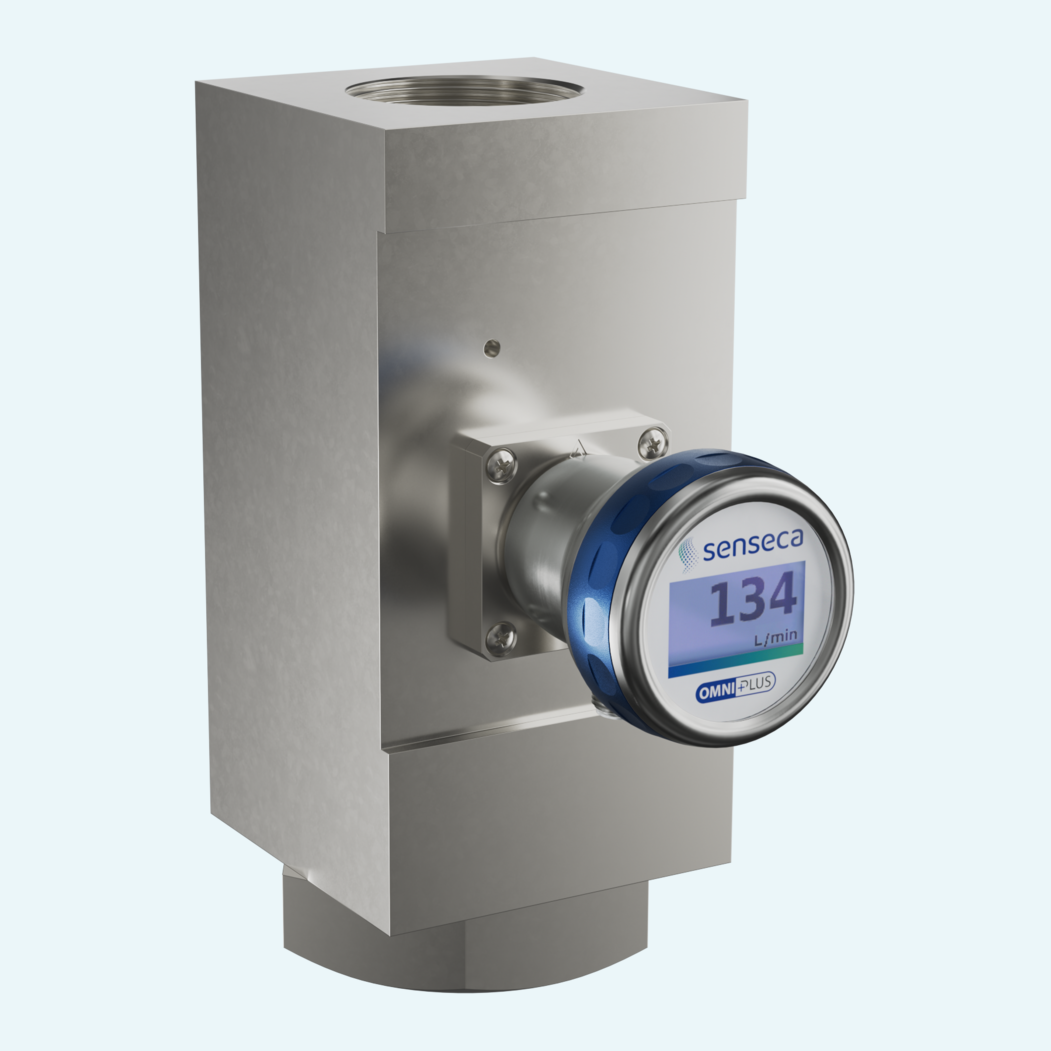


Large oil circuits need flow measurement that handles higher flow rates without making installation more complex. This transmitter family is designed for oils and other viscous media from 30 ... 200 mm²/s, with measuring ranges from 2 ... 200 l/min and no required inlet or outlet runs.
The spring-supported variable area principle gives the measurement a clear mechanical basis. A magnet-equipped float moves against a spring as the medium flows, while magnetic field sensors detect its position outside the flow chamber. DN 32, DN 40 and DN 50 sizes, female threads from G 1¼ to G 2 and 3 % full-scale accuracy support industrial flow monitoring in larger pipe sizes.
Integration is supported by one configurable analog output, two switching outputs and IO-Link V1.1. PN 200 pressure resistance, IP65/IP67 protection, brass or stainless steel versions and an optional +150 °C media temperature range with distance pieces make the family suitable for demanding process and machine environments.

The transmitter uses a spring-supported variable area principle. A magnet-equipped float is moved by the medium, and magnetic field sensors detect its position outside the flow chamber.
The product family covers DN 32, DN 40 and DN 50 with measuring ranges from 2 ... 12 l/min up to 100 ... 200 l/min for oil from 30 ... 200 mm²/s.
The devices use female threads from G 1¼ to G 2. Further connection types are available on request according to the source.
The analog output can be configured for current or voltage, including 4 ... 20 mA, 0 ... 20 mA, 0 ... 10 V, 2 ... 10 V, 0 ... 5 V, 1 ... 5 V and 0.5 ... 4.5 V.
Two push-pull transistor outputs can be set as limit switches, frequency outputs, pulse outputs or outputs for the preset counter.
The device supports IO-Link V1.1 with COM2 transmission, SIO mode, block parameterization and data storage.
The graphical 1.2 inch LCD has 128 x 64 pixels and uses white backlighting in normal operation and red backlighting for alarm messages.
The family is available in brass and stainless steel versions, with an optional extended temperature range to +150 °C using distance pieces.