Plant-focused light monitoring needs a sensor that measures photons, not just brightness. LPPAR01 measures photosynthetically active radiation as the number of photons striking a surface per second and area, supporting indoor applications that require constant monitoring of light in the PAR region.
The probe covers 0...5000 µmol·(m⁻² s⁻¹) with a spectral range of 400 nm...660 nm. A cosine corrected diffuser supports readings across different incidence angles, while <6% calibration accuracy and <6% cosine response error give users a practical basis for comparing and tracking light conditions.
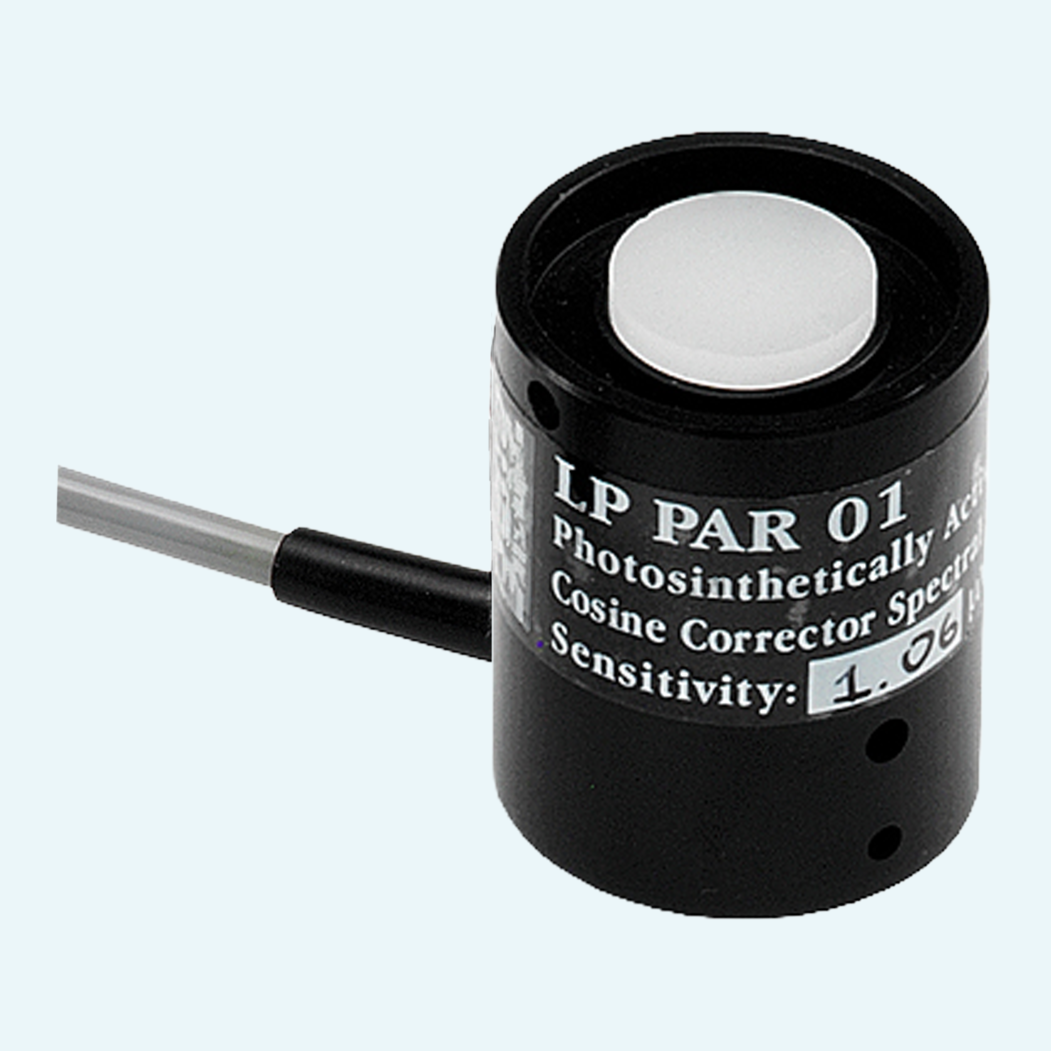
No external power supply is required. The photodiode signal is converted into a potential difference and read by a voltmeter or suitable acquisition device. Each probe is individually calibrated, with its sensitivity factor marked on the housing for direct calculation of the measured PAR value.


The probe measures the number of photons striking a surface in one second, divided by the surface area.
LPPAR01 measures within the PAR range used for photosynthetically active radiation, with a specified 400 nm...660 nm spectral range.
Light hitting the photodiode generates photocurrent, which is converted into a potential difference across a shunt resistor.
The PAR value is calculated from E = DDP/S, using the measured potential difference and the probe calibration factor.
The probe output should be connected to a digital multimeter with input resistance >100 kΩ for 1% reading precision.
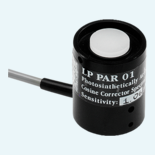
The probe includes a photodiode, filter, diffuser, case and 5 meters cable for connection to the reading instrument.