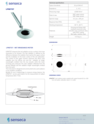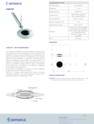
Energy balance studies depend on a clear view of the radiation entering and leaving a surface. LPNET07 measures net irradiance from near ultraviolet to far infrared by comparing the radiation on its upper and lower receiving surfaces, making it suitable for meteorology and outdoor monitoring in all weather conditions.
The thermopile sensor converts the temperature difference between the two receivers into a voltage by the Seebeck effect. With a ±2000 W/m2 measuring range, 0.2...100 µm spectral range and 180° viewing angle on both sensors, it captures direct and diffuse solar irradiance, sky radiation, ground reflection and long-wave radiation from the earth.
Built for long-term field use, the radiometer uses PTFE-coated receiving surfaces and operates from -40...+80 °C. It requires no power supply, is factory calibrated with a calibration report, and can also be used indoors for radiant temperature measurement according to ISO 7726.


The sensor measures the temperature difference between upper and lower receivers and converts it into a voltage by the Seebeck effect.
The upper surface measures direct and diffuse solar irradiance plus sky radiation. The lower surface measures reflected solar irradiance and long-wave radiation from the earth.
PTFE-coated spherical receiver portions provide a response according to the cosine law for irradiance incident from different angles.
The fixed 5 m cable has two wires plus shield, with red for +Vout, blue for -Vout and black for the cable shield and housing.
The radiometer should be installed clear of shadows, oriented south in the northern hemisphere and north in the southern hemisphere, at least 1.5 m above the ground.
The receiving surfaces should be cleaned regularly with water or pure ethyl alcohol when needed. Annual calibration checking is highly recommended.