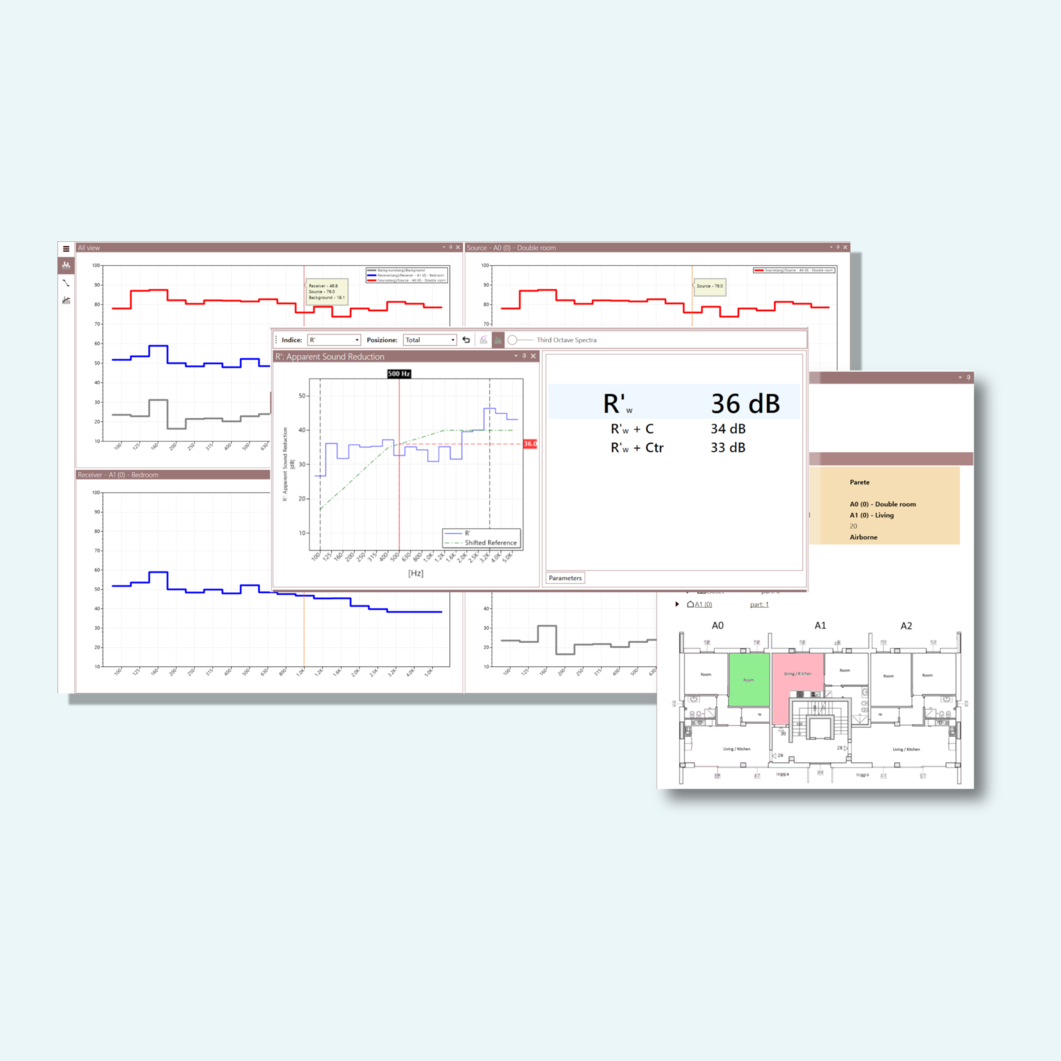
Sound Insulation Studio is a professional software platform for the analysis and verification of building acoustic performance, developed for acoustic consultants, engineering firms, testing laboratories, construction companies and public authorities. Fully compliant with ISO 16283 for field measurements and ISO 10140 for laboratory testing, it supports the assessment of airborne sound insulation, impact sound insulation, façade sound insulation and building service equipment noise.
The software provides advanced calculation tools, automatic comparison with national and customizable regulatory limits, comprehensive management of measurement projects, housing units and building components, and intuitive visualization of results. Customizable reporting features allow users to quickly generate professional documentation for design verification, testing, certification and regulatory compliance. With its user-friendly interface, continuous standards updates and powerful analysis capabilities, Sound Insulation Studio simplifies acoustic assessments while ensuring accurate, reliable and standards-compliant results for every stage of a building's lifecycle.

Automatic recognition of XPT800 measurement tags with classification of measurement types (Source, Receiver, Background, Reverberation Time, Impact Noise) and sound source position identification. Tag-based data management enables efficient organization, analysis and processing of large measurement datasets.
Hierarchical project structure management enables the organization of measurements and analyses by Housing Units, Rooms, Partitions and Service Equipment. The fully editable building model allows dynamic modification, addition and removal of acoustic elements throughout the project lifecycle.
Import of building floor plans enables accurate graphical representation of housing units, rooms and partitions under analysis. An automated space recognition function identifies the measurement areas, supporting efficient workflow management, especially in complex building layouts.
Automatic recognition of the measurement excitation method (interrupted source or impulsive response) with optimized processing of acoustic decay data. The integrated Schroeder backward integration algorithm enables precise calculation of reverberation time and related room acoustic parameters according to international standards.
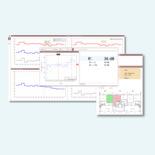
Comprehensive analysis of measured sound decay curves with advanced post-processing capabilities. The software enables graphical visualization of decay responses, calculation of reverberation time parameters (EDT, T10, T20, T30, T60, Tbest) and further evaluation of acoustic performance according to standardized methods.
Advanced multi-decay analysis allows simultaneous visualization of energy decay curves for each frequency band, providing detailed insight into frequency-dependent reverberation behavior. This functionality supports rapid evaluation of acoustic phenomena and facilitates accurate room acoustic analysis.
Advanced reverberation quality assessment according to ISO 3382, providing detailed indicators for evaluating decay curve reliability and acoustic field characteristics. The analysis includes Bandwidth × T60 (BT), Background noise influence (BK), Correlation (Co), Curvature (Cu), Standard Deviation (SD) and Non-linearity (NL) parameters for accurate validation of reverberation measurements.
ISO 717-compliant automated reporting with customizable templates and export options in Word, PDF and Excel formats for professional documentation and data analysis.
NS-SIS Sound Insulation Studio desktop application module for Building Acoustics