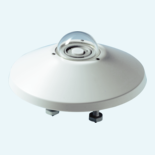
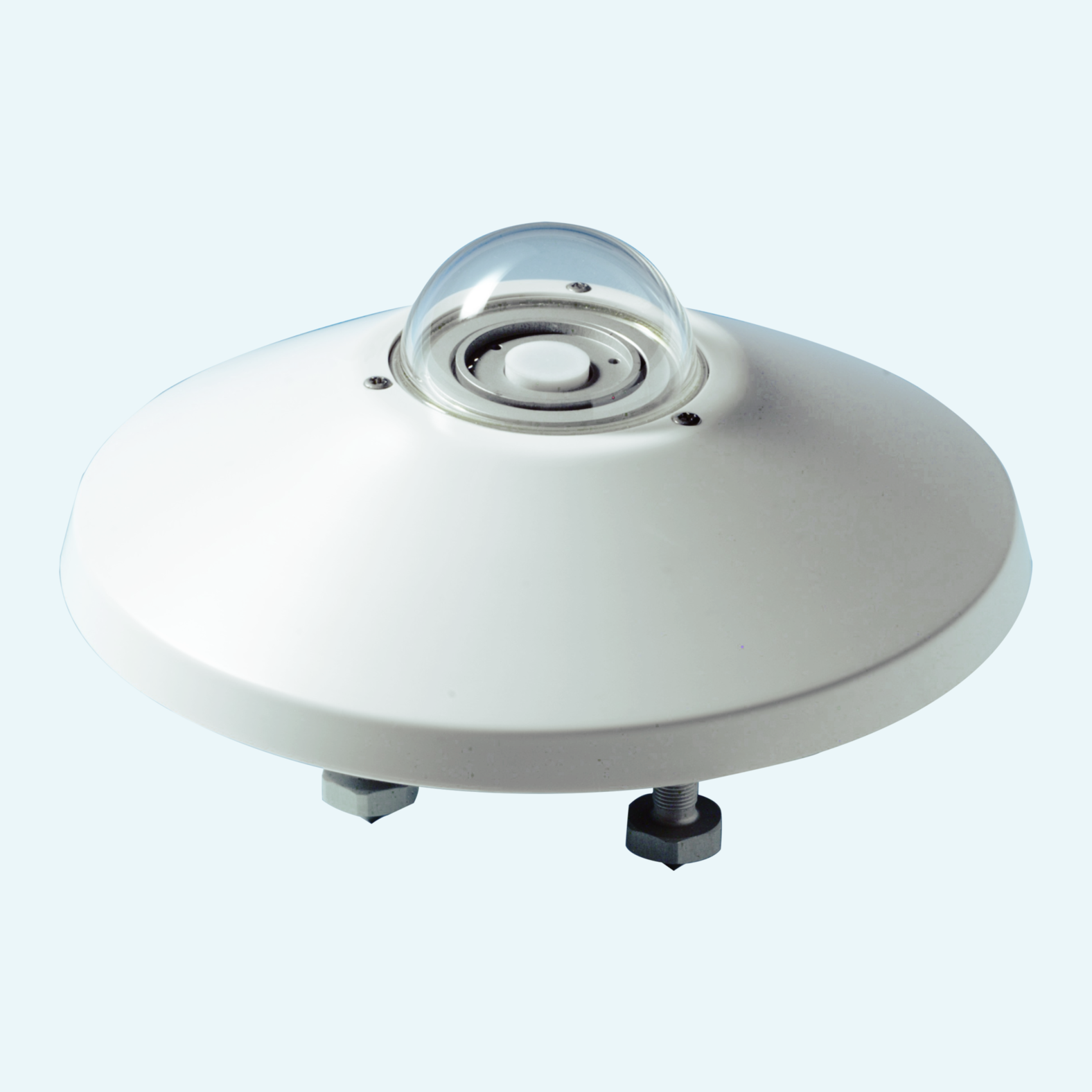
Reliable UV Index data helps meteorological stations assess solar ultraviolet exposure with confidence. This UV Index radiometer measures global effective irradiance on a flat surface according to WMO requirements, capturing both direct sun irradiance and diffuse irradiance in the ultraviolet spectral region.
The solid-state sensor has a spectral response adapted to the UV weighting curve ISO/CIE 17166:2019. A quartz dome protects the sensor against weather agents, while the cosine-law directional response supports accurate global radiation measurement even when the sun elevation is low. Versions with 0…16 UV Index or 0…20 UV Index measuring range cover standard monitoring and higher UV conditions in equatorial areas or high mountains.
Long-term operation is supported by IP 67 protection, an operating temperature of -40…+80 °C and analog voltage outputs of 0…1 V, 0…5 V or 0…10 V depending on the model. The design is suitable for remote meteorological stations when powered correctly.


The radiometer uses a solid-state sensor with spectral response adapted to the UV weighting curve.
It measures the sum of direct sun irradiance and diffuse irradiance on a flat surface.
Models are available with 0…1 V, 0…5 V or 0…10 V output and either 0…16 or 0…20 UV Index range.
Directional response follows the cosine law with specified deviation up to 80° incidence angle.
The housing includes fixing holes and a levelling device. An optional bracket supports installation on Ø 30…50 mm masts.
A silica-gel cartridge absorbs humidity in the dome chamber to help prevent internal condensation.
Code: LPUVI02 [1]
Example: LPUVI02.1AV5
[1] Option
AV = 0...16 UV Index range; 0...10 Vdc output
.1AV = 0...20 UV Index range; 0...10 Vdc output
AV1 = 0...16 UV Index range; 0...1 Vdc output
.1AV1 = 0...20 UV Index range; 0...1 Vdc output
AV5 = 0...16 UV Index range; 0...5 Vdc output
.1AV5 = 0...20 UV Index range; 0...5 Vdc output