
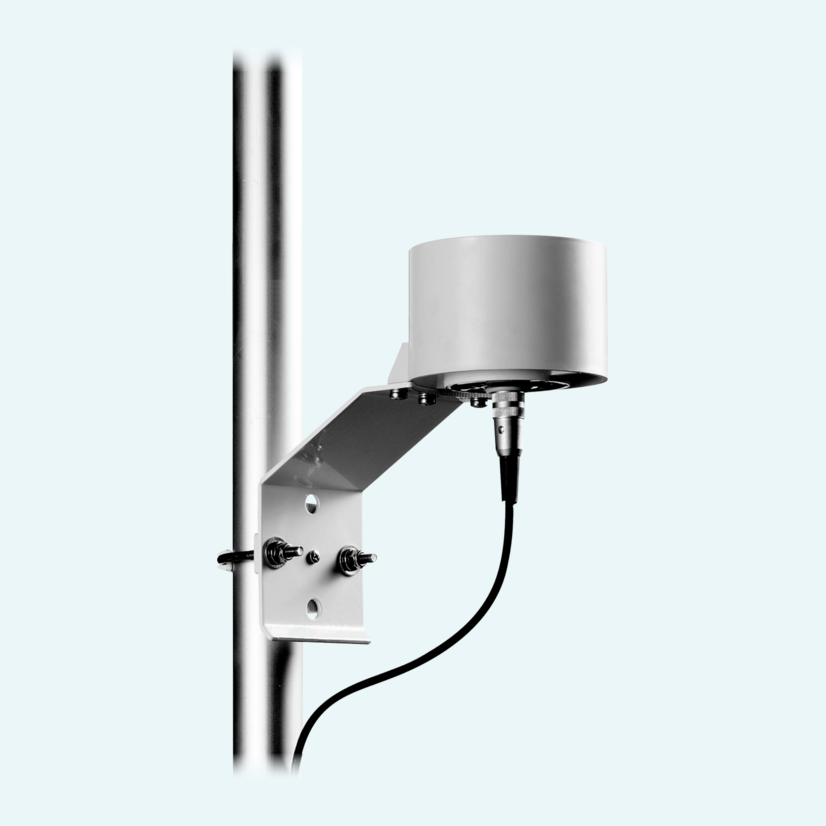
Reliable precipitation status is essential for weather stations, traffic systems and outdoor automation that must react quickly to rain or snow. HD2013.3 detects precipitation with a capacitive sensor, using the percentage of dry sensitive surface to indicate whether precipitation is in progress.
The integrated heater keeps the detector dry, evaporates water and helps prevent false signals caused by fog or dew. At low temperatures, it also melts snow, while the ambient temperature sensor allows the instrument to discriminate between rainfall and snowfall. An external circular dome works as a windshield for the sensor, reducing false indications from environmental effects.
Integration is flexible across monitoring and control systems. RS485 supports Modbus-RTU or a proprietary protocol, while model variants provide 0/4…20 mA, 0…10 V or voltage-free contact output. IP68 protection, ASA technopolymer housing and operation from -40…+60 °C make the detector well suited to demanding outdoor installations.


The sensor detects precipitation from the percentage of dry sensitive surface, with configurable 1% or 0.1% resolution.
Heating can operate manually, always on, always off or automatically, with configurable power in manual mode.
The detector can perform automatic calibration at regular intervals to compensate for temperature drift, aging and dirt.
The precipitation threshold, hysteresis, start delay and end delay can be adjusted via protocol settings.
The digital output uses Modbus-RTU or the proprietary protocol, with configurable address and communication parameters.
HD2013.3 provides 0/4…20 mA output, while HD2013.3AV provides 0…10 V or 2…10 V output, with reversible direction.
HD2013.3 and HD2013.3AV include a voltage-free normally open contact that closes when precipitation is detected.
The supplied bracket mounts to Ø 30…50 mm vertical or horizontal masts, with optional bird spikes available.