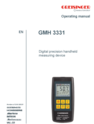
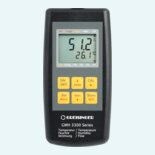
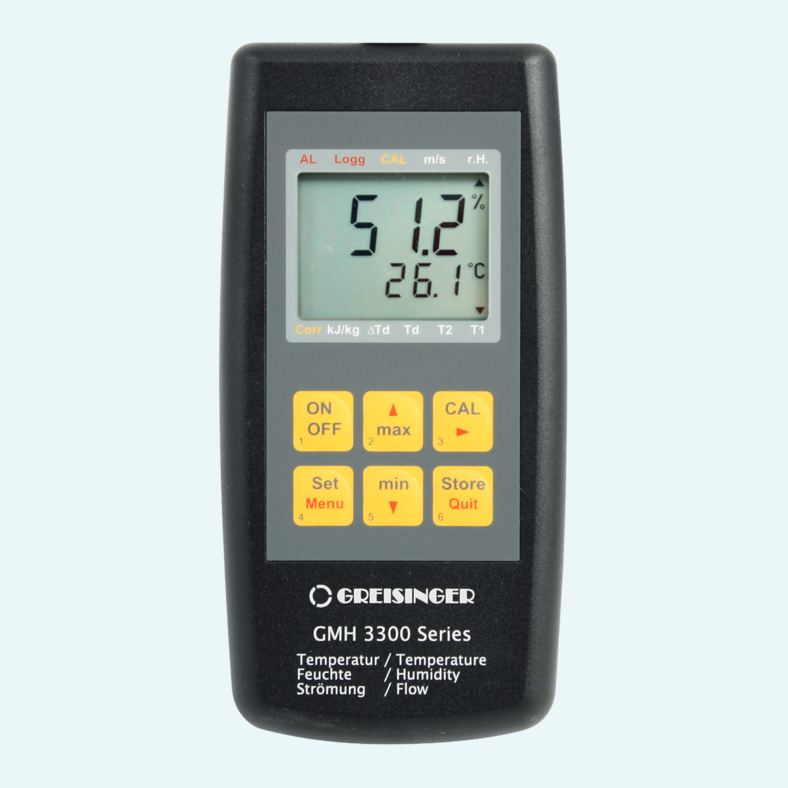
Room climate checks, building inspections and HVAC work need a wider view than a single humidity reading. This handheld meter combines relative air humidity, environmental temperature, surface temperature and flow speed in one field device, helping users assess indoor air conditions, heat exchangers, damp corners and building energy questions with one measuring platform.
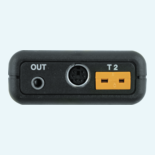
With the TFS 0100E probe, the device measures relative air humidity and T1 temperature and calculates dewpoint temperature, dewpoint distance and enthalpy. A separate Type K T2 input captures surface or medium temperatures up to +250.0 °C, which is useful when condensation risk depends on the difference between air dewpoint and surface temperature.
For flow work, STS 005 and STS 020 probes cover water and air flow speed, with continuous averaging or Average Hold available for steadier readings. The universal output supports PC connection via isolated interface converters, and the GMH 3351 variant adds logging, alarm and 0..1 V output functions.


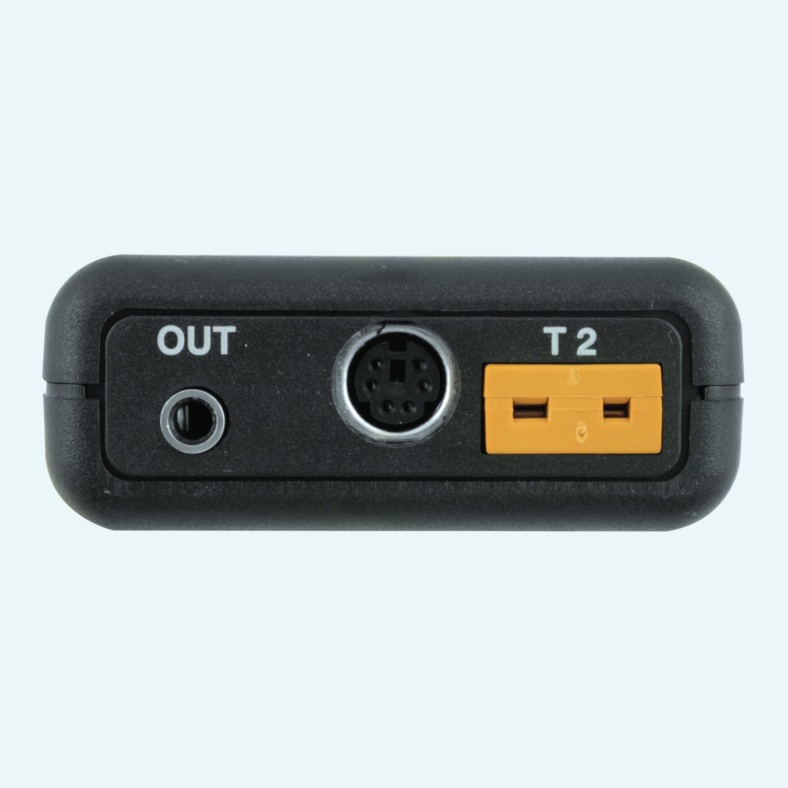
The 6-pole Mini-DIN sensor connection accepts TFS 0100E for relative air humidity and temperature, STS 020 for air flow and STS 005 for water flow. The Type K input accepts miniature flat plugs for T2.
The display can show dewpoint temperature Td, dewpoint distance ΔTd and enthalpy h based on the connected humidity and temperature measurements.
Two averaging processes are available for STS probes: continuous averaging and Average Hold. The averaging time can be set from 1..30 s.
The OUT connection can be configured as a serial interface for galvanically isolated adapters such as USB 3100, USB 3100N, GRS 3100 or GRS 3105.
The GMH 3351 variant adds alarm, data logger and 0..1 V analog output functions. The analog output can be scaled with DAC.0 and DAC.1.
The device supports 2-point local adjustment of the TFS 0100E humidity sensor using automatic recognition standards or manual values between 0% and 100% r.H.
Two 4½-digit LCD display lines show the main and auxiliary values. The integrated support stand can position the device on a surface, wall or belt.