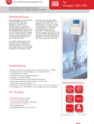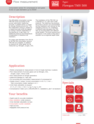


Compressed air and process gas costs become easier to control when consumption is measured directly at machines, systems or nitrogen generators. This insertion sensor records flow, consumption and velocity for air and gases such as nitrogen, oxygen, CO2, argon and nitrous oxide, helping users identify leakage air, check usage and build a clearer compressed air balance.
The calorimetric measuring principle uses the cooling of a heated sensor as the measuring effect, so no additional pressure or temperature compensation is required. Installation is practical on site: the sensor mounts through a standard G 1/2 ball valve, can be installed under pressure and uses an engraved depth scale for positioning in the pipe center.
For integration into industrial systems, the device offers 4–20 mA, RS 485 Modbus RTU and pulse output options. Versions cover pipes up to DN 300, operating pressure up to 50 bar and air velocities up to 224 m/s, with stainless steel wetted parts for demanding gas applications.

A heated sensor is cooled by the surrounding gas flow. The device uses this cooling as the measuring effect and records flow, consumption and velocity without additional pressure or temperature compensation.
Units are selectable by keys, including m³/h, m³/min, l/min, l/s, ft/min, cfm, m/s, kg/h, kg/min and kg/s.
The counter records total consumption up to 1,999,999,999 m³ and can be reset to zero from the keypad.
The inner diameter is set with the keypad, and an engraved depth scale supports positioning the sensor in the pipe center.
Factory setting follows DIN 1945 and ISO 1217 at 20 °C and 1000 mbar; other standard conditions can be set by keypad or service software.
Probe lengths from 120 mm to 700 mm are available for different pipe dimensions.